


.svg)

The Fourth Turning is Here - A Pivotal Era of Change & Transformation
"Do you just print it? No we don't, we print it digitally. The average House of Representatives member is something like 12 times richer than the average American household. Once people get elected, they almost always get richer."
"The COVID crisis has taken a toll on so many, and yet some people actually profited for the first time ever."
"President Donald Trump has been impeached twice."
"He had an amazing point about civilizations collapsing and that when they start collapsing, they become obsessed with gender. He was saying that you could trace it back to the ancient Romans and Greeks. The movement toward androgyny occurs in late phases of culture. Okay, as a civilization is starting to unravel, and you can find it again and again and again through history."
"It was unprovoked, but this is what Russian President Vladimir Putin unleashed on Ukraine—a huge blast in the center of Ukraine's second-largest city. Look at the destruction in Kharkiv, which is about the size of Philadelphia."
"BlackRock said that rebuilding Ukraine could take between 700 to 800 billion, and they're pointing specifically to the new partnership where they will advise the Ukrainian government on how to structure the country's reconstruction fund."
"On Capitol Hill, House Republicans have passed an emergency funding bill for Israel tonight, providing $14 billion in aid. But it does face opposition from the White House and Senate leaders who also wanted billions in aid for Ukraine in this bill."
"And obviously, all of this stuff that you're watching, seeing, it's pretty bad because we're getting more and more immune to it like it's becoming a normal Tuesday, normal Monday."
"I started by asking her whether there are any conditions attached to America's support for Israel, given the unfolding humanitarian crisis in Gaza. Her answer to that was very clear. She said, 'America stands behind Israel, period.' I also asked her whether America could afford to support two foreign wars at the same time. A similarly clear answer to that, absolutely, as the Biden Administration works to respond to the influx of migrants."
"There has been a record increase in the unhoused population this year. We are at the beginning of a very classic late big cycle debt crisis."
"Social Security Reserve funds are going to run out by 2034."
"France's president pushed through a plan to raise the retirement age to just 64. The reform is necessary to prevent the pension system from going bankrupt."
"They're still protesting, all this over being asked to work fewer years than Americans do. The only other alternative is printing money. I suspect that's what America will do. The politicians won't face this, but they'll get to the point where they don't have enough money; they'll just print more, and we'll be like Zimbabwe."
"Repos, repos, repos, and more repos. See these crazy auction prices for cars? So I can show you guys that the car market is actually failing. We're at a lot of people are saying, 'Oh, it's tax time, this is the time.' No, I'm telling you, people are running out of money. Americans are eating into their savings. Could this be a sign that everything's going to be okay? If yes, why? 84% of billionaires are saying that a recession is coming for next year."
"Are you optimistic about the global economy or pessimistic? - 'Pessimistic.'"
"The banking system is built on a house of cards, and it could collapse at any moment. And if it does, the federal government's going to have to come rob you of your money to give to a bunch of bankers again. That's our system."
Prologue
Feeling overwhelmed? Disoriented? Perhaps scared? The first paragraph is a pure chaos and mess of news and headlines from around the world, currently flying around haphazardly like moths to the fire of clout and attention. But amid the chaos that surrounds us, one might wonder: How do you make sense of this? Can you even make sense of this mess? If so, I might just have what you need right now to find your clear path in the endless world of fake news, misinformation, and propaganda
Around 30 years ago, a book was written that predicted all the chaos we're experiencing today. It foresaw 9/11 five years before it happened, envisioning a global terrorist group blowing up an aircraft and announcing its possession of portable nuclear weapons.
"The United States and its allies launched a preemptive strike; the terrorist threat to retaliate against an American city. Congress declares war, and opponents charge that the president concocted the emergency for political purposes."
- Quote from the Book.
The book also predicted COVID 23 years before it happened.
"The Centers for Disease Control and Prevention announced the spread of a new communicable virus; the disease reaches densely populated areas, killing some. Congress enacts mandatory quarantine measures."
- Quote from the Book.
And what happened after 2020:
"The World Health Organization has just released a report estimating that 15 million deaths occurred globally due to the pandemic."
- From the CBNS news.
How did the authors know these things were going to happen? Is it because they found some grand conspiracy? No, they saw all of this coming because of simple, predictable human nature and all that uncertainty you feel in the air right now. That ever-present feeling of uneasiness,where it feels like we're right on the edge of a giant cliff. You see, all of this is going right according to plan. In this book, the authors uncovered that history literally repeats itself in 80 to 100-year cycles. These cycles are called saeculum, and this is not some random number, by the way. Eighty to 100 years happens to be the average length of a human lifetime, and each of these saeculum is made up of four parts or four turnings of around 20 years each. The first turning is The High, an upbeat optimistic era that happens right after a big crisis like a war. People work together, people trust the government, things are great. But then comes the second turning, The Awakening, where people become disenchanted with the status quo. Then comes the third turning, The Unraveling, and finally, the fourth turning, The Crisis, a destructive 20 to 25-year period that ends with a catastrophic event like a war or revolution, where the current order is destroyed, and it gets replaced with a new order. Thus, the cycle starts all over again, and these cycles have repeated themselves over and over and over again.

In the past 300 plus years of Anglo-American history, the last crisis we had was World War II. The crisis before that was the Civil War, and the crisis before that was the Revolutionary War, and so on." Would you look at that? All these crises are magically 80 to 100 years apart. You know what that means, right?

Extend this pattern out, and you'll realize that we are deep into the fourth turning, already in the climax of this fourth turning. That single catastrophic event that's going to destroy the current order and replace it with a new one? Well, that crisis is just a few years away, exactly as destiny intended. What will this catastrophic event be? The best case: pure economic mayhem that will make the inflation we've been seeing right now look like a walk in the park. The worst case: war, a World War. But whatever the case may be, we have a pretty good idea of how things will play out because we already got a preview of it during COVID.
During this coming crisis, the government will print a bunch of money. Most of it will go to the 1%, and the little that the masses do get? Well, they will immediately transfer that money to the 1% anyways, just like what happened during COVID. Except this time, we will see the final form of this wealth transfer, where all that last remaining wealth will get squeezed out of the middle class and transferred to the 1%. So, if you thought the last few years were rough, it's about to get much worse. And if you and your loved ones don't want to get absolutely crushed along with the rest of the poor and middle class, well, you better start preparing right now. And if you think this won't affect you because you're not in America? Well, think again. Because even if there isn't a World War, due to how interconnected the world is today and because every country relies on the dollar, if America goes down, it will bring everyone else down with it and position some countries to profit. So, it's time to start preparing. That is why I am doing this three-part article.
In this first part, we're going to uncover the cycles of history to understand exactly what is going to happen next. In the second episode, we're going to go over the principles you need to know to start preparing right now, ensuring that you come out of the upheaval on top. Finally, in the third episode, we're going to go over what I'm actually doing right now to prepare, so that you can too.
These are by far the most important documentaries ever made, so you are not going to want to miss them.
And what is this book, you ask? Why, it's none other than "The Fourth Turning" by William Strauss and Neil Howe, which I will also link below. I highly recommend you read it. So, it's time for our rendezvous with Destiny
The High
The year was 1945. World War II was finally over, and America had just come out on top. The young adults at the time, known as the GI generation, had known nothing but suffering. They were raised during World War I and the Great Depression, only to be shipped off to fight in the deadliest war humanity had ever seen. And now, it was finally over, and they had come out on top. They came home to be celebrated as heroes.

And they were eager to finally enjoy some of the freedom they so desperately fought for. Enjoy they did—taking that same work ethic, patriotism, and fear of death that helped them win the war and putting that energy into American society. They took over jobs, got married, settled down, and had kids, ushering in an era of prosperity and unity. Everyone was on the same page, and there was political stability. The family was stronger than ever, gender roles between men and women were more defined, and trust in the government was higher than ever. Politicians, for the most part, actually took their jobs seriously, a stark contrast to today. Conformity was higher than ever as the masses happily fell in line with 9-to-5 jobs and white picket fences. There were no culture wars or infighting; they had already fought over everything worth fighting for. The future looked brighter than ever, and thus, the GI generation, or the hero generation, as we'll call it, propelled America into the fastest period of growth ever—the first turning, The High.
New inventions were being made left and right, consumerism and mass marketing became at thing. The American dream, with its suburbs, tract homes, love affair with cars, and appliances, was alive and well. The dream of working a 9-5 job at the same company for your entire life, and the company taking care of your retirement, actually worked. During The High, everyone was getting richer together, regardless of whether you were part of the lower, middle, or upper class, unlike today.

Going to the moon, eradicating poverty—all these impossible dreams now seemed achievable. Social progress was being created left and right, and the crazy part was, they were actually working because everyone believed in the system. No one was trying to game the system back then, unlike today. But nothing good lasts forever. While the GI's were being hailed as heroes, the generation beneath them, the Silent Generation, had a much different experience.

You see, while the GI generation was fighting the Great Depression and World War II, the Silent Generation, born just after the war, had a vastly different experience. As kids during this tumultuous period, they grew up with overprotective parents, well aware of the war raging around them. They had no right to complain, were expected to attend school, get a stable job, and tow the line. This was the average experience of a child growing up during the Great Depression and World War II
"Most of us kept quiet, attempting not to call attention to ourselves. To be a teenager was nothing, but the lowest of the low." - From "The Fourth Turning" by William Strauss and Neil Howe. When the war heroes returned home after World War II, all the praise and spotlight were on them, and the Silent Generation found themselves further cast into their shadows. Imagine an entire generation being raised under such circumstances—conformists who grew up hating themselves for conforming. They sought to find and express themselves, giving birth to cultural icons like the Beatles, Andy Warhol, and Jimi Hendrix. This type of generation is often referred to as the Artist Generation.
While the Artist Generation quietly conformed to their parents' expectations, the kids born just after the war did the exact opposite. By the end of the 1940s, war veterans were having kids in masses. As the hero generation that conquered the crisis and endured lifelong hardships, they now had everything they fought for. If you were one of them, how would you raise your kids? Probably like this: "I'm going to give my kid everything that I didn't have. I'll provide them with all the opportunities, freedom, and ensure they don't face any hardships. It's going to be amazing." In other words, as the hero generation, you would spoil them. Now, imagine this scaled up to the entire nation—that is how the GI generation raised the baby boomer generation.

The GI generation created good times, and those good times were about to raise a generation of individuals who hadn't experienced significant hardship. When this entire generation, having grown up without enduring much adversity, became young adults, they lacked an understanding of what it took to create The High they were enjoying. Consequently, instead of working hard to contribute and sustain the prosperity, they chose to let loose and party. Observing the mistakes and flaws of their parents, they rebelled against everything their parents had built.
Even though it was a time of prosperity, many issues were being overlooked—problems related to women's rights, civil rights, conformity, the suppression of self-expression, and the escalating Vietnam War. As the baby boomer generation transitioned from childhood to young adulthood, it was the perfect recipe for what is known as The Awakening. This type of generation is aptly named the Prophets, as they prophesier the start of the end. The Awakening for this generation occurred on November 22nd, 1963.
The Awakening
The assassination of JFK changed the mood of the entire nation. We transitioned from a High where everything was fine and dandy to The Awakening, where Americans started questioning who they were. Doubts about the government and authority began to emerge. Perhaps the government wasn't as virtuous as once believed. With the GI generation aging and assuming positions of power, they brought their attitude of "I'm the hero, so I know best" into the government.
Simultaneously, the Silent Generation, now entering middle age, experienced a collective midlife crisis. They resented themselves for conforming throughout their lives. The baby boomer generation, raised in a time of affluence and lacking worries about money or the economy, grew up spoiled. Consequently, both the Silent Generation and the baby boomer generation found something new to focus on: themselves.

The hippie movement, music festivals, LSD and psychedelics, protests against the war, corporate activism, civil rights demonstrations, and women's rights advocacy—nothing was too sacred; suddenly, working a 9-to-5 job was considered joining the rat race, going to college and getting a degree was seen as smothering creativity, and following orders, like registering for the draft, was akin to giving up one's free will.
If you had asked the GI generation a few years earlier if they thought any of these things would happen soon, they wouldn't have believed it, because it was The High. But now it was The Awakening. The nuclear family started to weaken, the gap between gender roles was narrowing, and society was splintering. All of this was inevitable. On top of that, since the hero GI generation was getting old and entering positions of power, they naturally wanted to secure themselves a ton of benefits.

Education, Medicare, urban renewal, conservation, and efforts against poverty and crime prevention were all part of the GI generation's plan to make America a better place. Their argument was reasonable: "We won World War II, things have been great, and we have a ton of money. The least you can do is take care of us now that we're old; we can totally afford it.
However, what the hero generation failed to consider was that the new working-class generation did not care about working in the same way. They were rebellious hippies focused on finding personal happiness. If they couldn't stay in an unhappy marriage for their kids, why would they stay in a dead-end job just because the company or the country needed them to? Consequently, none of the spending on social programs proved sustainable.
While America poured billions of dollars into social programs, marking the era of "free stuff," the country's economic growth began slowing for the first time ever. Suddenly, Americans had to add the term "stagflation" into their vocabulary. Faced with a desperate need for money, in 1971, President Nixon took the U.S. off the gold standard. Before, the amount of dollars America could print was limited to the amount of gold it had. Now, the money printer was let loose. From 1971 onward, something strange occurred—the economy kept growing, but it was no longer everyone getting richer together. Instead, only the rich were getting richer, while the middle and lower classes essentially flat-lined, a trend that persists to this day.

But that wasn't all; inflation skyrocketed from around 4% at the start of 1971 to more than double that at 8.8% in 1973. By the end of the '70s, inflation would be up to 12%. While middle and lower-class incomes stopped growing, the middle and lower classes also started getting absolutely shackled in debts.

College tuition also suspiciously started skyrocketing after 1971.

In 1971, this Awakening would sow the seeds of the crisis we face today. As time went on, the Artist Silent Generation started having kids. Remember how the Artist Silent Generation had a rough upbringing during the Great Depression and World War II, how they were forced to conform their whole lives by the GI generation, and now they were busy finding themselves? Well, if you were them, how would you raise your kids? Probably like this
"I'm not going to be strict and mean or overprotective of my kids like my parents were to me. I'm not going to impose my values on them. In fact, I'm barely going to raise them at all because I'm too busy finding myself."
And so, the Artist Generation gives birth to The Nomad Generation.

And The Nomad generation is exactly how it sounds. As a kid in the Nomad generation, you would have to raise yourself while your parents were out there finding themselves and protesting the next outrage. You would find what your parents are doing as super cringe, so you say screw the greater good; there's nothing worth fighting for. You don't worship anything—you don't worship your country, you don't worship social causes like your parents, and you definitely don't worship God.
But here's the thing—humans naturally have to worship something, so you end up worshiping yourself. Whereas the last generations were at least fighting for something—war, peace, civil rights, women's rights—this entire generation of Nomads would not fight for anything at all except for their own personal gain. This generation will become known as Generation X. Now, imagine every single child in the country getting raised like this. As these individuals become young adults, it would be a recipe for decay; it would be a recipe for The Unraveling.

The Unraveling
Oath of Affirmation:
"I do solemnly swear (or affirm) that I will faithfully execute the Office of President of the United States, and will to the best of my Ability, preserve, protect, and defend the Constitution of the United States."
- This is what presidents swear upon taking office.
The Awakening awoke people to the fact that not all is well with society. However, now that they had done all the fighting, all the protesting, what next? It's akin to having a really bad fight with your partner where you both say all the mean things you've been holding back for years—things that you can never take back. Sure, it felt good in the moment, but now that The Awakening is over, you make up and try to move past it. Deep down, you know your relationship is never going to be the same, and over time, you slowly let your relationship rot until you eventually break up. Now, imagine that scaled up to the entire country—that is The Unraveling. It's an ever-so-slow decay of society where everyone looks after themselves and no one else.
World War II, the American high, and even the Awakening had united Americans behind a common cause. But the Unraveling did the exact opposite; it splintered Americans into thousands of niche groups and factions. Things became more polarized than ever, and how does it look
"America's niche group conflicts came to be known as the culture wars—defined as a profound division over what kind of country we are, what kind of people we are, and what we mean by the American way of life."
"Conspiracy theories abound, whether about FBI helicopters buzzing over Idaho or the CIA spreading aid in inner cities."
"Only one American in five counted on the president or Congress to act responsibly."
- From "The Fourth Turning" by William Strauss and Neil Howe, pertaining to how The Unraveling unfolds
It was every man for himself, and no one could be more selfish and self-absorbed than the Generation X Nomads who were becoming young adults. They didn't care if their actions hurt America or their community. They weren't going to sacrifice anything for the good of the people—no, no, no. The perfect example of this was the rise of the Wall Street yuppies. Young Americans flocked to Wall Street not to contribute to society but to extract as much money from the masses as possible. It was the age of corporate raiders; "greed is good" became the unofficial slogan. Politicians followed suit, no longer pretending to have a sense of duty to serve the people—they were just in it for themselves. And this greed showed in the economy too. The money printer was ramping up, social programs were getting bigger and more bloated than ever before. The market kept going up and up, only to crash bigger than it ever has before in the 1987 Wall Street Crash. Then came the dot-com crash, then 9/11 and the war on terror. Every boom and bust cycle kept getting bigger and bigger, then came the real estate bubble, and then it happened...
In 2008, America officially entered the fourth turning, The Crisis, and today we are still deep into the fourth turning with only one way out.
"I am asking Congress to amend this bill and increase the ridiculously low $600 to $2,000."
- These were the words from Donald Trump in response to a question about how he intended to tackle the median household budget spending monthly, deeming it too low and not affordable during COVID.
"President Biden's $1.9 trillion COVID relief packet."
- Biden signs $1.9 trillion COVID relief bill, clearing the way for stimulus checks, vaccine aid. Published Thu, Mar 11, 2021
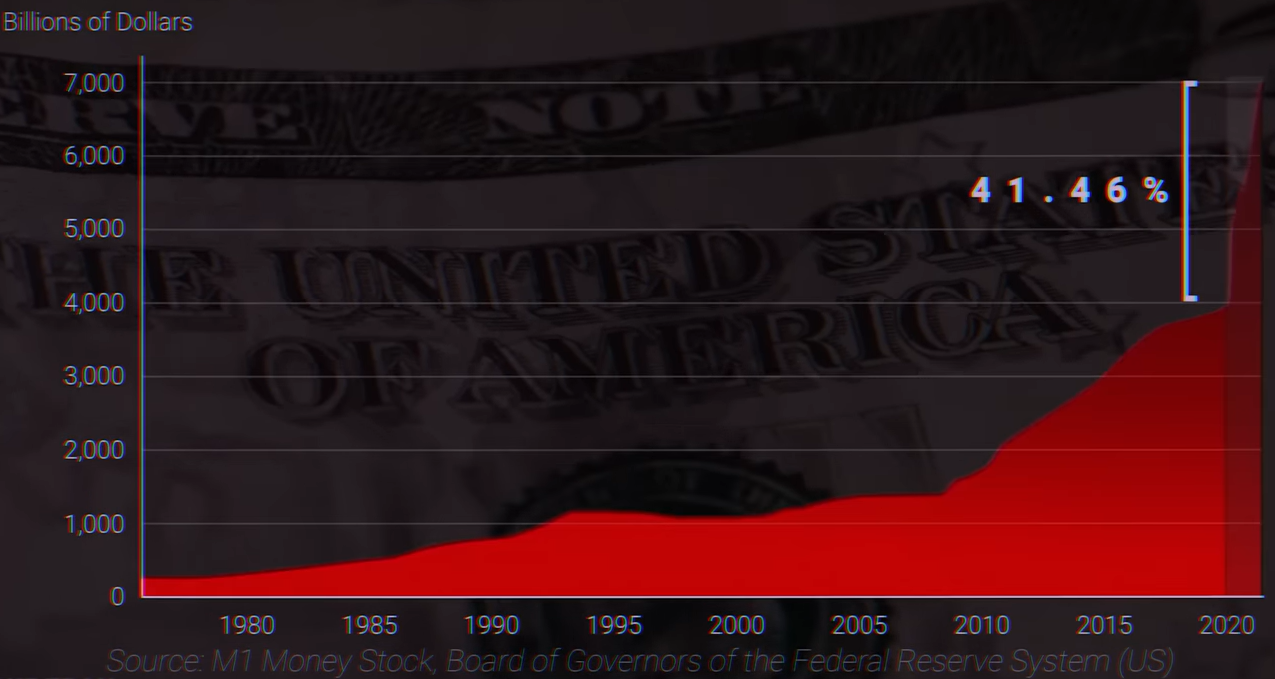
Given the straight-from-the-FED report, we started this period (before COVID) with around $4 trillion US Dollars in the system. One year later, that number is at $6.7 trillion, meaning that over 40% of all US dollars were printed in just the last 12 months.
“The stock market suffered one of its worst days in years Monday. Investors reacted to a stunning reshaping of the landscape of Wall Street that took out two storied names, Lehman Brothers and Merrill Lynch.”
- Quote from Associated Press from Stocks Fall Hard Amid New Wall Street Landscape.
“Another anxiety attack on Wall Street, even after the AIG bailout, the Dow-stock tumbled another 450 points."
“The CEOs of those banks still got bonuses? Oh yeah, yeah, yeah, they all still got bonuses. So they had to give them bonuses; otherwise, they would leave and go other places. It shows areal eroding of something completely different than the political system, just our culture. There wasn't at least enough shame for those people to just go, 'Yeah, I'm not going to take my bonus this year because I don't want to get dragged through the streets and killed by the citizens of this country. I don't want to feel like that.' And it's not as if these people didn't already have tens of millions of dollars; like, they really needed their bonus from this year or little Timmy isn't going to get his Thanksgiving turkey. Yeah, it's like, 'No, I want a fifth yacht.' It was like that level.”
-Joe Rogan Experience Podcast with a senior bank overseer.
“Since the 2008 financial crisis, we adopted a policy of inflation. We didn't call it inflation; we called it quantitative easing, but that was just the euphemism for inflation.”
- Peter Schiff from Euro Pacific Asset Management.
"Though I know that what I just described does not come cheaply, the failure to do so will cost us dearly."
- These are the words of Joe Biden after the release of the $1.9 trillion COVID relief package.
Right now, nobody seems to think that this is a problem. People believe that we've stumbled upon the equivalent of a monetary Fountain of Youth. Some like to call it Modern Monetary Theory, suggesting that we can have whatever we want as long as the government prints the money to pay for it, with the notion that there's no limit and the government is free as long as they print money. However, the problems keep stacking up: Ukraine's military reports that all but one of the drones were intercepted and destroyed, with five people wounded, including an 11-year-old girl. The collapse of First Republic Bank adds to the financial troubles. Another bank, another shoe drops. So, I asked, do you have any predictions on how bad it is going to get?
"A lot more banks are going to fail,"
- Peter Schiff, economist, financial broker-dealer, and author
After a few days of the events described above. And like magic, after he uttered those words, the following happens:
Signature Bank, Silicon Valley Bank filed for bankruptcy, and Switzerland's biggest bank UBS agree to take over its troubled rival Credit Suisse. As fears grow that the Middle East could be on the brink of a wider war, the Hamas-Israel crisis unfolds.
Remember a couple of years ago when everyone was talking about how the market was going to crash soon? Even I wrote articles on that, but the market never crashed. Once again, our central planners were able to kick the can down the road one last time. But now it looks like we might finally be running out of road. As you all know, inflation is much higher right now than the government is reporting. So, the Federal Reserve has finally stopped the money printer and has been raising interest rates to try to stop the inflation.

And we have never raised interest rates as rapidly before, and yet, look around you—inflation doesn't seem to be going anywhere.

That's why I brought Peter Schiff back to ask him about that, and here's what he told me:
"You know, the Fed was looking at the CPI and they kept saying we don't have enough inflation; it's still below 2%. So they kept trying to ratchet the rate up to get to 2%, and now, of course, it's way above it. An example that a lot of people can relate to is like when you're taking a shower. You get into a shower, and the water's too cold. So you turn up the heat a little bit, and then it's still too cold, and you turn it up a little bit more, and it's still too cold. You keep notching it up ,and then all of a sudden, it's scalding hot, and you burn yourself. You end up turning it up too hot, but there's a lag between turning up the temperature and water actually heating up and making it out of your faucet. And you keep thinking, 'I didn't turn it up enough. I don't get the immediate effect of the warmer water,' and by the time I get the effect, it's too hot, and I burned myself. And that's what the Fed was doing. They kept turning the inflation knob and looking at the CPI and seeing, 'Oh, we're not at 2%. Let's do more. Let's do more.' Now, all of a sudden, it's a lag, and now it's not 2%; it's 10%. And there's nothing they can do now. The genie's out of the bottle, and there's no putting it back in." - Peter Schiff
This is because of the lag effects: all those 40% of US dollars that were printed during COVID…

Yeah, all that money is still not done working its way through the economy yet. That's why we still have inflation. And on top of that, the high-interest rates where people can't afford cars or homes or loans anymore, and guess what? These interest rate hikes also have lag effects.

In fact, every time the Fed has raised rates a lot in the past, there has always been a recession afterward, but there's a lag. Take a closer look at the left part of the graph:
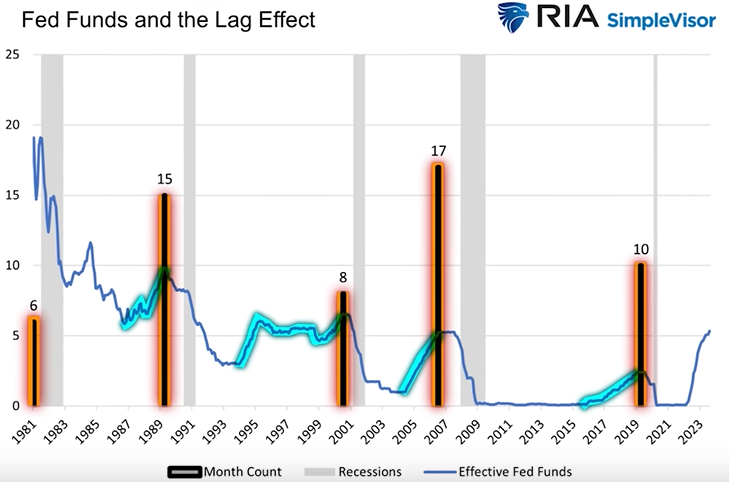
the Blue Line shows the interest rates; those black bars are where the Fed stopped raising rates, and these black bars show how many months it took us to go into a recession. In 2001, it took 8 months for a recession to happen; in 2007, it took 17 months; in 2019, 10 months. So, on average, it takes 11 months for a recession to happen. And guess what:
“The Federal Reserve today paused its recent interest rate hikes, leaving them unchanged after 10 straight increases” - CBS Evening News. Fed hits pause on interest rates hikes. Yep, our central planner overlords just stopped raising interest rates. People are saying they may raise rates one more time in January, but that's it, and they're going to start lowering it after that, which means we are going to have a recession around 11 to 12 months from now. I am not saying this because I have a crystal ball; we know this is going to happen because this is what the central planners want. They say it out loud. So, if you think inflation is bad right now when we have high interest rates, wait until the Fed lowers rates again. So, I asked Peter Schiff again, how bad do you think the inflation can get?:
He answered, “well, I mean it can get much worse and it will get much worse because there's really no political motivation to stop it because the only way to stop the inflation really would be to have dramatic cuts in government spending. The government has to get rid of the 2 to 3trillion dollar or more a year deficits, which means dramatic across-the-board cuts to government spending, including entitlements like Social Security, Medicare. That's not going to happen, so the Fed's going to have to keep printing money, which means the money is going to keep losing value, and prices are going to keep going up faster and faster. Eventually, the Fed is going to be printing money and buying bonds to prop up the banking sector, which is completely insolvent right now thanks to government policy and Fed policy, and to prop up a lot of other things because the economy is close to imploding. So the Fed is going to try to rescue it by creating inflation, which is always how the Fed reacts; that's the only play in their book.When there's a problem, they create inflation to solve it. Well, in the process, they've created an inflation problem. And now, if they try to use inflation to solve these other problems, they're going to make the inflation problem much, much worse” - Peter Schiff
So, you have around 12 months to prepare before things start getting bad, and we're already seeing signs of what's to come…
The Crisis
"Social Security Reserve funds are going to run out by 2034" - John Stossel, Ticking Time Bomb: Social Security & Medicare Are Broke
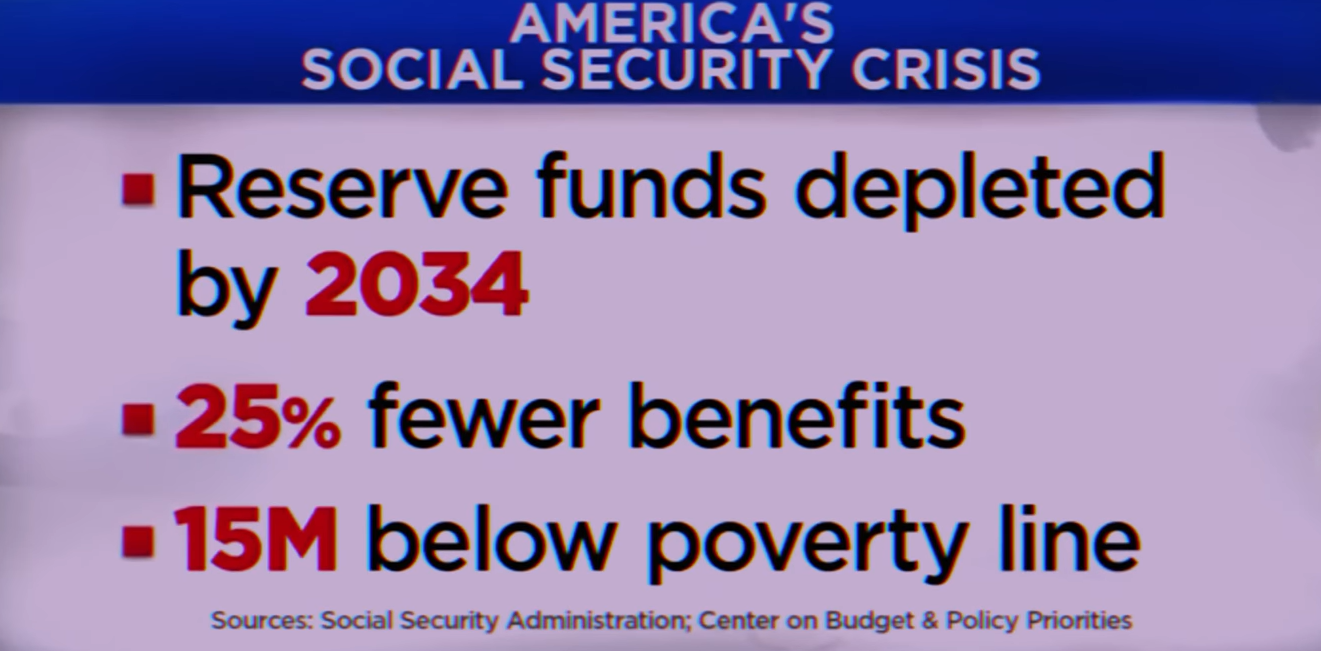
One thing that's probably going to happen during the crisis is that if you and your parents were planning on relying on the government to retire, well, good luck because Social Security is set to run out in the next decade. This means that most of the masses today are going to be spending their Golden Years greeting people into Walmart because this stuff is just not sustainable. There are just too many old people, along with all the other financial problems we're about to talk about. This one hits home for me because this was one of the main motivations for me to make money. My parents were planning on relying on the government to retire, and it's not just America; we're seeing this happen all over the world, in places like France, where they just have to raise the retirement age because they can't afford to support these old people. Look at the rise that happened just because of the Rebellion, Protest, and Culture Wars.
Then there's the national debt; just the interest alone on the national debt is over $2 trillion now.
"That means it's going to be the single biggest expense that the government has. It'll be bigger than social security and bigger than Medicare. Now, that is an enormous amount of money,and, you know, maybe a year after that, the interest on the national debt could be so big that it consumes half of all the income that the government collects in taxes"
- again, Mr. Schiff's answer pertaining to the Social Security & Medicare problem

Which means it's not just retirement money that's going to run out soon. Soon, the government isn't going to be able to afford anything – no more welfare, no more food stamps, government salaries – unless they print more money, which they would try. And again, it's not just the US;this is a global debt crisis. If anything, the US is in a better position because we print the money our debt is owed in.

"We've been kicking it down the road since the 1987 stock market crash. That's when Alan Greenspan, an American economist who served as the 13th chairman of the Federal Reserve from 1987 to 2006, first introduced this playbook, and everyone else has been following it ever since. So, we've got about 40 years or so of can-kicking. During those years, the problems have really grown. It's like having 40 years without an earthquake or a forest fire, and then when you finally get one, it's terrible because you didn't have the smaller fires or the smaller quakes to take the pressure off or get rid of some of the drywood. So, when it happens, it's really bad. We are going to have a horrible crisis because we were able to postpone it for as long as we did. We've had many crises along the way, but that was just a small taste of what's coming. At the end, there are no bailouts because the Fed has bailed everybody out by creating more inflation, but they won't be able to do that anymore without the inflation itself being the problem."
- Mr. Schiff asked about the debt and money printing, and postponing the Crisis for so long
Combine this with the fact that the world is on the verge of a new world war every single week,and political uprisings, food shortages, energy shortages, social unrest – nothing is off the table.And although all this may sound like fear-mongering, when you take a look at the seculum Fourth Turning book, you'll see that we're right on schedule. As always, when this crisis comes, it would be the poor and the middle class that suffer the most, and all their last remaining wealth will just get transferred to the rich, just like COVID. But if you don't want this to be your fate, the good news is that you still have time to prepare. You've got 12 months before a recession, thanks to the lag effects, before things start getting really bad. And if you want to prepare, it's safe to say that the average 9-to-5 job, where you can get laid off at any moment,is not going to cut it. Twelve months may sound like a lot of time to prepare, right? Wrong. Think about how quickly this last year flew by; it's December already. Yet, most people will wait until January to start working on their goals. And by the time February rolls around, they will already have let off the gas. Then, what do you know, it's June already, halfway through the year. And at the rate of how fast things are moving, who knows how the world is going to change by then?So, if you really want to prepare, if you really want to make sure you come out on top, you have to start preparing in these literal moments we're talking about. What are you going to do in the next hour, or tomorrow, or the next few days?
Our parents, grandparents, and great-grandparents may have gotten us into this mess, but it's our duty to make sure we come out on top. The last crisis we had was World War II. At that time, FDR (Franklin D. Roosevelt) was President, and you know what he said about the hero generation back then:
"There is a mysterious cycle in human events. To some generations, much is given; to other generations, much is expected. But this generation, this generation has a rendezvous with Destiny."
- Franklin D. Roosevelt, his words align with the book Fourth Turning
So, you reading this right now are the hero in this crisis, and it's time for your rendezvous with Destiny. In part two of this documentary series, I am going to go over exactly what you need to navigate this crisis so that you can make sure you come out on top. Stay dangerous.
- Kacper Patryk Sobczak on the book "The Fourth Turning" by William Strauss and Neil Howe.
You might Also Like

Niccolò Machiavelli: He Who Wrote the Ultimate Guide for Dictators
A guidebook to rulers on how to gain and consolidate power, The Prince was considered so dangerous it was banned by the Catholic Church for more than 200 years. It has not only paved the way for tyrants, despots and dictators but has had a profound impact on business, politics, religion and the halls of power on every continent of the globe. But what did Machiavelli say? Who did he influence and how has what a man wrote 500 years ago, shaped the modern world in which we live today? From the White House to the Kremlin from the Vatican to the Federal Reserve, this is how a man from Florence changed the course of history. This is how the writings of Niccolò di Bernardo dei Machiavelli are used to manipulate and control everyone.
Read More
The New Prospect of Idealogy in 21th Century
It can now be said that Confucianism is based on ethical principles and social behavior. Therefore, we may see a renaissance of these traditional Eastern religions and philosophies in the future, providing people with guidance and direction without conflicting with scientific reality.The Western world is highly secularized, with many people turning away from traditional religions and instead focusing on science, technology, and individual freedom. However, this trend has also led to a crisis of identity and the search for meaning. People are increasingly dissatisfied and isolated, and they are seeking new ideologies or communities to fulfill their needs.
Read More
Why Fascism Stems From Ordinary People, Not Monsters
The spiritualizing or heightening of violence. Anti-rationalism, a reaction to the Enlightenment. Heroism and action over religious debate or thought. Myth and story over rationalism and materialism. Vulgar or Social Darwinism, the scientism of struggle. Ultra-nationalism and Völkisch thought as a crisis of capitalism and liberalism. Authority and order over freedom and chaos. Anti-Bolshevism or anti-universalism. Paramilitarism. The reality and shock of World War One. And establishment support from big money and big politicians.
Read More
