


.svg)

The World War II Essay - European Theatre (part 1)
Part 1 of 3
Intro
"Ladies and gentlemen, permit me, please, to claim your attention for but a moment."
In the words of Winston Churchill in the Second World War, every bond between man and man was to perish. Crimes were committed by the Germans under the Hitlerite domination to which they allowed themselves to be subjected, which find no equal in scale and wickedness with any that have darkened the human record. The wholesale massacre by systematized processes of six or seven millions of men, women, and children in the German execution camps exceeds in horror the rough-and-ready butcheries of Genghis Khan, and his scale reduces them to pygmy proportions. Deliberate extermination of whole populations was contemplated and pursued by both Germany and Russia in the Eastern war.
The hideous process of bombarding open cities from the air, once started by the Germans, was repaid 20-fold by the ever-mounting power of the Allies and found its culmination in the use of the atomic bombs, which obliterated Hiroshima and Nagasaki.
Causes of The Second World War
Germany disarmed after the struggle of the First World War, and the victors, sufficiently armed in vigilance, but errors were soon made. America's failure to enter the League of Nations, the weakness and lack of resolution of Western democracies to confront the growing strength of the fascist dictators in Germany, Italy, and Japan, and the economic turmoil that allowed these events to spark and build upon reflection. It is all too easy to see and understand how this tragedy could have been avoided, but for those in power at the time, they failed all too well to see the Gathering Storm that confronted them.
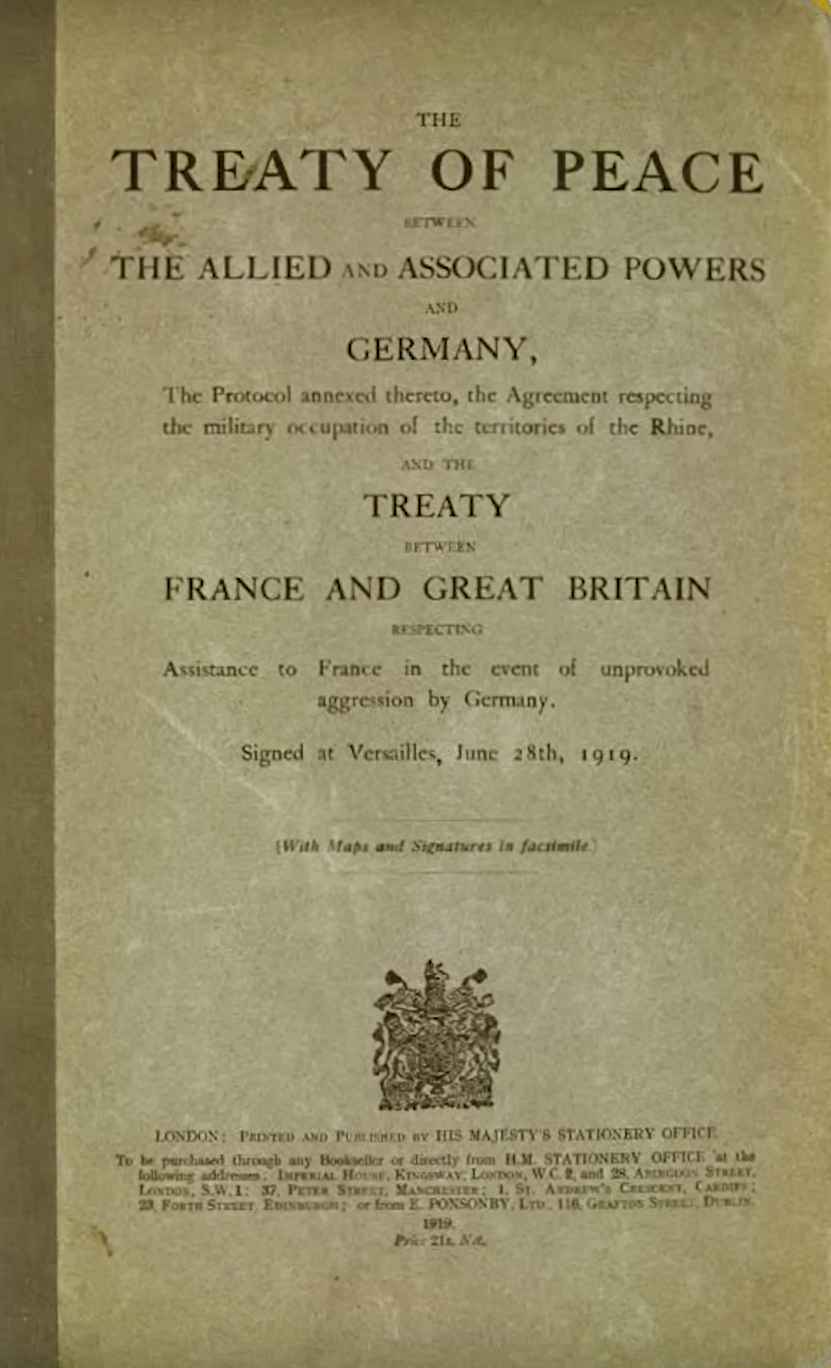
The origins of the Second World War can be found within the confines of the Palace of Versailles. Germany's surrender in the First World War was a shock to both the international community and its people. Militarily, Germany had been successful on the Eastern Front, with troops deep within France, and Germany itself was untouched. However, on November 11th, 1918, at 11:00 a.m., the 11th hour of the 11th day of the 11th month, a ceasefire came into effect, and an armistice had been signed. The war to end all wars had come to an end. The proud peoples of Germany had been defeated, the Allies victorious after four years of suffering and untold casualties, wanted to see Germany pay to ensure something like this would never happen again.
An international institution was to be established in the hope of bringing about a new world of collective security, later seen in the form of the League of Nations. In early 1919, the Germans were summoned to Versailles, not to negotiate but rather to hear the terms they would have to implement. Indur David Lloyd George of Great Britain, Woodrow Wilson of America, Georges Clemenceau of France, and Orlando of Italy all attended with the aim of weakening Germany.
World War One had radically altered the political European map with the defeat of the Central Powers, including Austria-Hungary, Germany, Bulgaria, and the Ottoman Empire. The German state that came out of the Great War was also to experience profound change and suffer severe territorial losses. Germany was to lose a portion of its eastern land, creating a new Polish state and establishing a Polish corridor between Germany and East Prussia, giving Poland access to the sea. The port city of Danzig, the largest city on the coast, was given to the League of Nations. Memel in the Baltic was handed over to Lithuania, Alsace-Lorraine to France, and the mineral-rich Saarland was to be administered by the League of Nations for a span of 15 years, with the Rhineland becoming a demilitarized zone providing France with additional security.
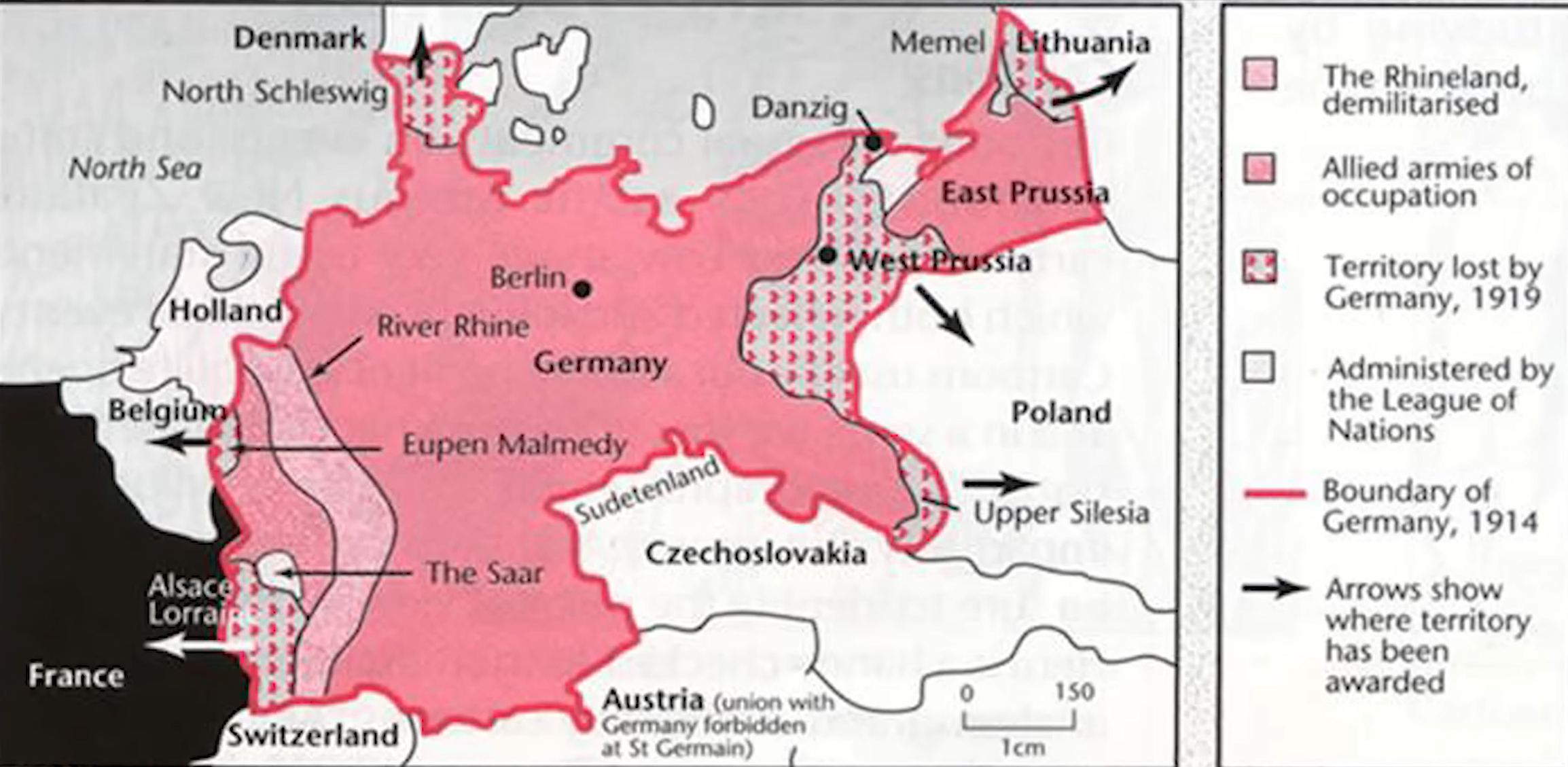
The German colonies in Africa were distributed to the British and the French, and their South Pacific colonies would be given to Japan. In addition, military clauses were added to the treaty: the German army could be no larger than a hundred thousand troops, they were allowed no air force, no tanks or heavy artillery, and the German Navy could have no more than six warships, with no U-boats or submarines.
Insult being added to injury, a war guilt clause was placed in the treaty, making Germany accept full responsibility for the outbreak of the war, as it was only on this basis that the Allies could demand reparations. France and Britain had begun the war as creditor states but had ended as debtor nations and wanted to be repaid. The sums been asked of Germany in reparations were many times more than was possible for them to pay, placing a severe burden on their economy, which later contributed greatly to economic instability and hyperinflation.
John Maynard Keynes, the primary representative of the British Treasury at the time, said:
"I believe that the campaign for securing out of Germany the general costs of the war was one of the most serious acts of political unwisdom for which a statesman have ever been responsible."
The German people believed they had been bitterly betrayed by the high command and unjustly treated by the international system, views that would lead to materialize throughout the 1920s and 30s.
Rise of The Third Reich
After the Wall Street Crash of 1929 and the preceding Great Depression, the world was plunged into economic turmoil, and Germany was hit hard. American banks withdrew the loans they had made to Germany, and the economy collapsed overnight. Due to such large reductions in cash and capital, banks struggled to provide money and credit. In 1931, there were runs on German and Austrian banks, with several of them closing, and businesses closed at an alarming rate. By 1933, unemployment had reached 6 million, many people were left homeless, and thousands of children died from malnutrition.
In the lack of government resolve and out of despair, many turned to alternative political leaders and parties in the hope their problems would be solved. One man, in particular, garnered a lot of attention with his rousing speeches, and this man was Adolf Hitler. Hitler's speeches delivered clear culprits for Germany's problems: the November criminals who had signed the Armistice ending World War I, the liberals and socialists who had signed the Treaty of Versailles, the Communists who threatened revolution in Germany, and finally, the Jewish bankers who plotted to undermine and destroy the German state.
The Nazi and communist parties both clashed violently, and Hitler claimed to be the only one to bring about order and end the red plague. As a powerful and gifted public speaker, Hitler was able to capitalize on public discontent. His party, the National Socialist German Workers Party or the Nazi Party, grew to record levels. In September of 1930, the Nazi Party had increased its representation in the Reichstag, the German parliament, almost tenfold, winning 107 seats. Only two years later, in 1932, they won 230 seats, becoming the majority in parliament.
in parliament Hitler had found the failures and misery of the Great Depression to his advantage stating for:
"Hard reality has opened the eyes of millions of Germans."
In the 1932 election, Hitler also ran for president, and although he lost, a decorated war hero, Paul von Hindenburg, his rise in popularity gave President Hindenburg no choice but to appoint Hitler on the 30th of January 1933 as Chancellor of Germany, head of the German government. Just one month after Hitler had been sworn in as Chancellor, a fire was started in the Reichstag by a young Dutch communist, which was then used to paint all communists as the enemies of Germany.
Using Article 48 of the constitution, the Reichstag Fire Decree was passed, abolishing civil liberties such as freedom of speech and freedom of the press. Shortly after, Hitler created a secret police known as the Gestapo, helping him to suppress any and all opposition. As Chancellor, he also tripled the size of the German military, violating the Treaty of Versailles, banned all rival parties, killed political opponents, and prohibited Jews from working, voting, and occupying public spaces. After the death of President von Hindenburg in 1934, Hitler declared himself Fuehrer of Germany, an absolute dictator.
Hitler’s Vision
Believed the world to come would be dominated by four main superpowers. Germany was to be the main hegemonic power of mainland Europe, the British maintaining their international empire, the Japanese (or the Aryans of the East, as Hitler liked to call them) would be the main power in Southeast Asia and the Pacific, and finally, America would dominate the Western Hemisphere.
Part of Nazi support was their opposition to the Treaty of Versailles, and upon coming to power, Hitler promised to return Germany to its rightful place in the world. Hitler's objectives were clear: the economy needed to be self-sufficient, what the Germans called "economic autarky," being able to produce their own goods and not relying too heavily on imports. This was critical to withstand a British blockade to trade, a policy that had damaged Germany in the First World War.
Germany would also need Lebensraum, or living space, that would facilitate the growing German population. Lebensraum was to be found in the east, and this meant Germany would have to expand into Poland, Czechoslovakia, Ukraine, and agricultural regions of the Soviet Union. For Hitler, this new German Reich that was to be created was to be racially pure, containing only the Aryan race, free of Slavs and Jews, of whom had to leave or be eliminated. It was also Germany's mission to launch a crusade against Judeo-Bolshevism, an ideology and enemy that took the form of the Soviet Union, a war he thought would inevitably have to happen.
Failure of The International System
The international system that had been envisaged was not able to cope without the support of the British and the United States, absent following a policy of non-interventionism. France was left alone to maintain and enforce the Treaty of Versailles, something many think it couldn't and didn't want to do alone.
Held in Geneva, Switzerland, the disarmament conference provided a preview of how Hitler operated and what future Nazi policy would look like. Hitler instructed his representatives at the conference to state that Germany would completely disarm if and only if France, Britain, Japan, and the United States would do the same. This was an offer that Hitler correctly assumed would be denied. He went back to the German people and showed them how this conference was not about disarmament but rather aimed at keeping Germany subjugated. In 1933, Hitler withdrew from the League of Nations and the disarmament conference, gaining the support of his people.
In 1934, to the surprise of the international community, Germany signed a non-aggression pact with Poland, taking an ally away from France and weakening France's military positioning. In March of 1935, Germany revealed it had built an air force, the Luftwaffe, breaking the Treaty of Versailles with the justification being that Britain, France, and Poland all had an air force, and Germany too needed to defend itself. One week later, Hitler declared his intentions to introduce conscription to build an army of half a million men. Once again, the League of Nations protested, but no action was taken, and the disarmament clauses outlined in the Treaty of Versailles were effectively destroyed.
In June of 1935, to France's horror, Britain entered into a naval agreement with Germany, the Anglo-German Naval Agreement, in which Britain recognized Germany's right to build up its navy. Germany was to be allowed up to 35% of Britain's surface tonnage and a submarine fleet up to 60% of Britain's. Britain had struck a deal, giving up on Versailles and disarmament, signaling to Hitler that a policy of appeasement was to be pursued.
A year later, in March 1936, German troops were sent into the demilitarized Rhineland. The matter was referred to the League of Nations, which once again did nothing. The remilitarization of the Rhine was the final nail in the coffin for the Treaty of Versailles and the international order. The treaty was now officially dead, and France, in response to German occupation of the Rhine constructed a Maginot Line along its eastern borde.
The Age of Strategy
However, the fortification stopped at the Ardennes Forest and did not extend across the Belgium frontier, the place at which Germany had entered during the Great War. The French were preparing for a war of the trenches and were not prepared for the motorized divisions that made German blitzkrieg tactics so effective.
Stalin, at this time, threatened by German power and aggression, entered the Soviet Union into the League of Nations and also signed an agreement with Czechoslovakia stating he would come to their aid if attacked, but only if the Western Allies would come to its defense first. This was to stop the West from trying to push German aggression eastwards. Hitler wanted all German-speaking nations in Europe to be unified, especially his native homeland Austria. Under the terms of the Treaty of Versailles, Germany and Austria were forbidden to be unified, as the Allies hadn't fought for years to see a large Germany. Austrian President Schuschnigg, knowing he would receive no help from Italy and that France and Britain would not interfere in Hitler's plans, resigned, and two days later, German troops marched into Austria unopposed. Hitler had successfully annexed Austria under the guise of national self-determination as justification.
After the successful occupation of the Rhineland and the annexation of Austria, Hitler turned to Czechoslovakia, of which three million people in the Sudetenland were of German origin. The Czech government hoped that Britain and France would come to its assistance in the event of a German invasion, but British Prime Minister Neville Chamberlain was intent on avoiding war. He made two trips to Germany in September and offered Hitler favorable agreements, but the Fuhrer kept increasing his demands. On the 30th of September 1938, Hitler attended a meeting in Munich, accompanied by Britain, France, and Italy, all of whom agreed that Hitler should have the Sudetenland as long as he promised to go no further. The Soviets and the Czechs were not represented at the meeting, and realizing that no country would come to their aid, Czechoslovakia was forced to surrender the Sudetenland to Germany.
After the meeting, Chamberlain went to Hitler and asked him to sign a peace treaty between Great Britain and Germany, to which Hitler happily agreed. Upon his return to Britain, Chamberlain delivered his "peace in our time" speech to cheering crowds. To people at the time, Neville Chamberlain was a great champion, the Munich Agreement had won the peace, and war was averted. But from this, Hitler saw Europe is weak and unwilling to stand up to his demands. Winston Churchill, one of Chamberlain's greatest critics, said, "You were given the choice between war and dishonor. You chose dishonor, and you will have war." Churchill was proven right when just half a year later, on the 15th of March 1939, German troops marched into Czechoslovakia. Once again, Hitler had broken an agreement.
France and Britain then guaranteed Poland's safety, with Britain also beginning to rearm and install a highly secret radar system along its east coast. On August 23rd, 1939, the Germans and the Soviets signed a non-aggression pact, which sent shockwaves across the world's diplomatic community. The signing of this pact, for Hitler, ended the prospect of a two-front war, which allowed for a greater taking of Poland. But for Stalin, this bought him time to rebuild the Red Army that he had purged. As the last days of summer arrived, there was a sense in Europe that war was imminent, and the sense was right.
Blitzkrieg
Blitzkrieg, or lightning war, revolutionized warfare and allowed an attacker to destroy an opponent before they were even mobilized. Through the use of tanks or Panzers, German forces were able to quickly smash border defenses and encircle enemy troops. They were supported by tactical airpower, the Luftwaffe, providing close aerial support to ground operations. Using this tactic, Germany could swiftly incapacitate opponents, allowing them to conduct operations without the need for the total mobilization of the economy and society, as the First World War had required. The First World War was a war of attrition, something Germany wasn't in the current position to win or endure. This new mode of warfare, therefore, focused on speed and efficiency.
Poland
On September 1st, 1939, Germany, with 52 divisions and over 1 million men, made their way into Poland, attacking through the north and south, destroying the Polish Armed Forces. Britain responded with an ultimatum to Germany to cease military operations. The ultimatum was ignored, and so France, Britain, Australia, and New Zealand all declared war on Germany, with Neville Chamberlain broadcasting the announcement on the radio.
The German attack was led by five armored divisions containing 300 tanks apiece, followed by four motorized infantry divisions carrying their artillery and equipment, with cover provided from the air by the Luftwaffe. Believing that the invasion would be stopped by British and French intervention, the Polish were slow to mobilize and poorly prepared to face the German onslaught. Upon mobilization, the Poles sported 1.3 million men but possessed outdated equipment and only a few tanks. With the German armored and motorized divisions outnumbering the Polish 15 to 1, equipment was so scarce and outdated for the Poles that cavalry squadrons were seen charging into heavily armored German tank divisions.
The invasion worked with greater speed and efficiency than planned, and by September 8, Warsaw, the Polish capital, had been reached. Once Germany had broken Polish resistance, Stalin moved troops into Poland, keen to regain territory that had once belonged to Russia before the 1917 revolution. Poland was now to fight a war on two fronts that it couldn't win, and so, on the 27th of September, 1939, Polish commanders negotiated a ceasefire, with the last Polish military unit surrendering on October 6th. Altogether, Poland lost 70,000 troops against the German invaders and another 50,000 against the USSR, with 133,000 being wounded. The Germans took over 700,000 Polish prisoners, and the Soviets took another 300,000. 150,000 Poles managed to escape, many coming to Great Britain and enlisting in the armed forces.
For Hitler, the invasion of Poland was his third successful annexation of a foreign country. He had achieved his objectives, and the Western powers had once again done nothing. This period became known as the "Phoney War" because Britain and France took no military action despite declaring war on Germany. Blitzkrieg had been a major success, and over the next few months, Hitler continuously claimed that he didn't want a war in the West.
The Winter War
Three months after the invasion of Poland, Stalin was concerned about Finland falling under German influence, given that Leningrad was only 20 miles away from the Finnish border. The Soviets demanded that the Finns cede territory on the Karelian Isthmus to put Leningrad out of danger. The Finns refused, and on November 30, 1939, the Soviet Union launched military action.
Despite the Soviet Army outnumbering the Finns 50 to 1 and having superior equipment, the Finns fought with great tenacity. Wearing white uniforms to blend into the snow and outmaneuvering the Red Army, Finland resisted Soviet attacks for more than two months and inflicted considerable damage. After the Soviet military reorganized itself and adopted different tactics, they continued their offensive in February, overcoming Finnish defenses.
The war came to an end in March 1940 with the signing of the Moscow Peace Treaty, which saw Finland surrendering 11 percent of its territory to the Soviet Union. The performance of the Red Army against Finland encouraged Hitler to believe that an attack on the Soviet Union would be successful. It also confirmed to the Western powers that the Soviet military was not the best equipped or organized, though this wouldn't be fully tested until another 15 months later with the German launch of Operation Barbarossa.
Scandinavia
In April 1940, Adolf Hitler embarked on a significant strategic gamble. His plan involved sending the full strength of the German Navy along the Norwegian coast, from Oslo to Narvik. The primary objective was to protect the coastal waterways, allowing the safe transportation of Swedish iron ore to German blast furnaces. By gaining control of Norwegian waters, Germany aimed to make an Allied blockade of the country more challenging.
The British discontent over the Norwegian campaign and an Allied withdrawal resulted in the resignation of Neville Chamberlain on May 10, 1940. On the same day, Winston Churchill, a man who had consistently warned about German rearmament and the threat posed by Hitler throughout the 1930s, was appointed as his successor.
Battle of France
On May 10, 1940, Germany launched an attack against France, Belgium, Luxembourg, and the Netherlands. French troops quickly positioned themselves along the Maginot Line, while the rest of the Allied soldiers took positions along the Belgium and Luxembourg borders. As Belgium was neutral, Allied soldiers couldn't enter the country to prepare a defensive position, and they had to wait for Germany to invade.
Germany initiated their offensive with a massive air assault in the early morning, deploying over a thousand fighters, bombers, and dive bombers. They targeted Allied airfields, effectively destroying the Allied air force on the ground and securing air superiority for the Luftwaffe throughout the offensive. Just three hours after the attack, Belgium allowed Allied troops to enter the country.
With the great mobility of German Panzers and motorized infantry divisions, the Allied forces couldn't establish a practical defense in time. Luxembourg was captured within the day. The German invasion demonstrated remarkable efficiency, employing three army groups: Army Group A, B, and C. Army Group B targeted the Netherlands and then advanced into Belgium. Army Group C attacked through the Maginot Line, protecting the flank of Army Group A, the largest force.
Army Group A pushed through the Ardennes Forest, a naturally fortified area that the French did not expect to be breached. Over 41,000 vehicles successfully navigated the Ardennes Forest, crossing the Meuse River and capturing Sedan by May 15. They then headed west, cutting off and surrounding the entire Allied army that had advanced into Belgium. This unexpected move forced the Allied soldiers to withdraw to the port of Dunkirk to protect their flank.
Dunkirk
With the Allies completely surrounded by German forces, Winston Churchill initiates a plan to evacuate the British Expeditionary Force from northern France. On May 26, Operation Dynamo begins, aiming to rescue the 400,000 stranded Allied troops on the beaches of Dunkirk. The Luftwaffe relentlessly attacks the soldiers on the beaches and sinks many ships, while German artillery fires upon the shore. In response, the Royal Air Force launches a counter-attack to protect the ships and soldiers.
The beaches at Dunkirk are shallow, and even destroyers cannot approach within a mile of the shore during high tide. As a result, the troops must be ferried out in small craft. On May 31, hundreds of civilian vessels, known as "little ships," cross the English Channel to participate in the evacuation. Fishing boats, lifeboats, sailing barges, ferries, and supply ships all contribute to bringing the soldiers home.
Although the British Expeditionary Force survives, almost all heavy artillery and equipment are left behind. By June 4, 1940, 338,000 troops have been evacuated, marking the events at Dunkirk as a miracle and the largest evacuation in military history. The surrender of France follows three weeks later, after Mussolini declares war on France, and German troops march into Paris, sealing France's fate. In just six weeks from May 10, 1940, German forces conquer France, Belgium, Luxembourg, and the Netherlands, allowing Hitler to dominate the European continent with unprecedented victory in just 35 days. This campaign later becomes known as one of the most remarkable military achievements in history.
Britain Alone
The future of the free world hung in the balance, and Britain faced a perilous situation after the fall of France. All that separated the Germans from yet another victory was the English Channel, and the isolationist United States was an ocean away. This left only one man to make a decision that would change the course of human history.
As the fighting continued, Germany began to consider ways of resolving the question of how to deal with Britain. Hitler hoped that Churchill would come to his senses and sign a peace treaty. However, if the British refused, Hitler's only option was to invade. Churchill then delivered his famous "We shall fight on the beaches" speech, transforming him into a world statesman. In this speech, he unequivocally declared that he would never make peace with Hitler.
War was now inevitable, and Germany had to plan an invasion of Great Britain. The invasions of France and Poland had taken months of meticulous planning, with every intricate detail of battle carefully considered. However, the invasion of Britain had to be ready by August 15th, as ordered by High Command, giving them just one month to prepare.
Battle of Britain
As the Battle of Britain unfolded, the British took strategic measures to fortify their defenses. Southern England saw the construction of coastal fortifications, removal and replacement of signposts to sow confusion among potential invaders, the incorporation of barbed wire in fields to discourage airborne troops, and the establishment of a Home Guard consisting of individuals ineligible or deemed too old for regular military service.
In parallel, Hitler set his sights on the invasion of the British Isles, unveiling Operation Sea Lion. This ambitious plan involved deploying 20 divisions to the southern coast of Britain via amphibious landing craft. However, the formidable English Channel presented a formidable challenge. Despite British commitments across the globe, the Royal Navy maintained numerical superiority over the German Navy. Admiral Erich Raeder, the German naval chief, expressed skepticism about controlling the channel long enough for a successful invasion.
Realizing the naval hurdle, Germany pivoted its focus to securing control of the skies. The Luftwaffe, boasting significant numerical superiority, positioned itself as a formidable force against the Royal Air Force (RAF). The British, with fewer than 700 operational fighters, faced daunting odds. Advanced planes on both sides, such as the British Supermarine Spitfire and Hawker Hurricane against the German Messerschmitt Bf 109, engaged in intense dogfights. The British, leveraging radar technology, implemented the world's first integrated air defense system along the southern and eastern coasts, offering early detection and coordination for RAF Fighter Command, led by Air Chief Marshal Hugh Dowding.
As the Battle of Britain unfolded, the initial German assault targeted airfields heavily, yet British radar provided ample warning. The Luftwaffe, losing 46 aircraft to 12 British planes in the early days, faced formidable resistance. Subsequent attacks intensified, leading to significant losses on both sides, with British losses mounting rapidly.
In a pivotal turn, the Luftwaffe shifted tactics to night attacks. However, a major blunder occurred on the night of August 24th when a group of German bombers mistakenly bombed London. The RAF responded with a retaliatory raid on Berlin the following night, signaling that Britain could both defend and retaliate. Hitler's decision to shift focus to bombing London, rather than the airfields, alleviated pressure on RAF bases, allowing for repairs and reconstruction.
The Battle of Britain reached a climactic point on September 15th, aptly named Battle of Britain Day. The Luftwaffe launched an all-out assault on London, aiming to break Fighter Command's resistance and pave the way for a potential invasion. However, the RAF staunchly defended against incoming waves of Luftwaffe formations, resulting in a decisive defeat for the German air force. Losing 61 aircraft compared to the RAF's 31, the Luftwaffe faced an overwhelming setback. Recognizing the failure to attain air superiority over Britain, Hitler, on September 17th, postponed Operation Sea Lion.
With foreign pilots, particularly those from Poland, France, and Czechoslovakia, playing a crucial role, the Royal Air Force successfully repelled the Nazi invasion. Expressing gratitude to those who fought, Churchill famously declared, "Never in the field of human conflict was so much owed by so many to so few." The prospect of a Nazi invasion of Britain became untenable. Hitler, acknowledging the difficulty, turned his attention eastward, initiating Operation Barbarossa, the colossal invasion of the Soviet Union.
The Blitz
The battle was far from over; instead, a new phase had commenced—the Blitz. British cities endured relentless bombing in nightly air raids, with London facing attacks for 57 consecutive nights, interrupted only once. On November 10th, 1940, the historic 14th-century Gothic cathedral in Coventry met obliteration. To safeguard citizens, children were evacuated to the countryside, while Londoners spent most nights seeking refuge in air-raid shelters or the Underground.
A strict blackout policy was enforced after dusk, shrouding cities in darkness to thwart German efforts to identify locations. Throughout the eight months and five days of the Blitz, nearly 2 million homes were reduced to rubble, and 40,000 civilians lost their lives, with an additional 87,000 suffering severe injuries. Despite the devastating impact, the relentless bombing failed in its primary objective—to demoralize the resilient British population into surrender.
Operation Barbarossa
As the full might of the German war machine turned towards the Soviet Union, a titanic struggle emerged—a clash of ideologies and civilizations where only one could emerge triumphant. Hitler's disdain for communism fueled his desire to secure victory over the Soviet Union, unlocking access to the abundant natural resources that could propel Germany to the status of the master race. Operation Barbarossa stood as Hitler's grandest gamble, a response to the inability to conquer Great Britain in the West.
Fortunately for Hitler, the Red Army, once the world's largest, had been severely weakened by Stalin's purges during the 1930s. The invasion of the Balkans in April 1941 secured Germany's southern flank, paving the way for Operation Barbarossa. With over four million men, 3,000 aircraft, and three army groups, the audacious plan unfolded. Army Group North aimed for the Baltic States and Leningrad, Army Group Center pushed towards Moscow, and Army Group South targeted the Ukraine.
Despite the Red Army's numerical advantage, Germany boasted superior technology and maneuverability. On June 22, 1941, Operation Barbarossa commenced, launching a devastating assault on Soviet airfields. Hitler's Panzers swiftly advanced, penetrating over 50 miles within two days. By July, the blitzkrieg had captured Smolensk, placing the Panzers on standby while the rest of the army caught up.
Yet, challenges arose in the south, prompting Hitler's controversial decision to redirect Army Group North towards Kiev. The seemingly boundless Soviet manpower proved challenging, and the halt at Smolensk allowed Stalin to mobilize over 16 million troops. The introduction of the T-34 tank shifted the balance, and Army Group North laid siege to Leningrad instead of capturing it.
As Army Group Center prepared for an assault on Moscow, bad weather intervened, stalling the German advance just 50 miles from the Soviet capital. Hitler's earlier decision to divert troops south now backfired, as the Soviet winter arrived, exposing German vulnerabilities. Tank engines failed, weapons froze, and soldiers suffered frostbite, leading to a December 5th halt of the German attack.
Stalin, seizing the opportunity, moved Siberian divisions westward, well-equipped and trained for winter warfare. In a counteroffensive, Soviet forces pushed the Germans back for seven days, ultimately halting the German advance. Hitler's order of no more retreats marked a desperate attempt to salvage the situation.
The battle shifted southward, focusing on the city of Stalingrad, unleashing one of the longest and bloodiest conflicts of World War II. Street by street, house by house, room by room, both sides endured immense casualties. Over a hundred thousand German soldiers surrendered, turning the tide in favor of the Soviets. Germany lost three hundred thousand men, mirroring Soviet losses, but the strategic balance had shifted.
The Soviet army continued its success, pushing German forces back in a series of offensives. Over a few months, Germany lost over a million men, prompting a retreat to protect flanks. The Soviet winter offensive reclaimed significant territory, marking the beginning of the end for the German war machine in the East. Never again would Germany launch a major offensive in this theater of the global conflict.
Epilogue - Move to the Pacific Theater (See Part 2)
On November 26, 1941, a formidable Japanese carrier fleet sailed into the Northern Pacific with a singular objective: the US naval base nestled in Hawaii known as Pearl Harbor. This audacious move marked a pivotal moment, shifting a conflict primarily confined to European theaters into the deadliest global conflagration in human history. The events that unfolded in the Pacific would thrust the United States into the heart of World War II.
Sources
The used sources list:
- A lecture series by Professor Thomas Childers, PhD
- The Rise and Fall of the Third Reich by William L. Shirer
- The Third Reich at War by Richard J. Evans
- The Second World War. Vol.I. The Gathering Storm by Winston S. Churchill
- The Second World War. Vol.2. Their Finest Hour by Winston S. Churchill
You might Also Like

The Multilevel Marketing Illusions: False Freedom, Financial Ruin, and the Cult of Success
Again, I ask you, if it sounds too good to be true, but believing otherwise means losing hope,why wouldn't you refuse? It's important that you pay close attention now because when a pyramid scheme or a cult is presented to you, it will not reveal itself as such. It will come wrapped in well-decorated packaging with a pretty bow on the top, disguised as a million-dollar opportunity, disguised as a way to work when you like, set your family free financially. When it presents itself to you, it will not come dressed in the robes of an unfamiliar character; it will come dressed as your best friend, your neighbor, someone you admire, someone you love. Its message will be that of hope and that of all you've ever wanted. It will come disguised as anything and everything but that of which it actually is - MLM: Lies, Pyramid Schemes, and the Pursuit of Financial Freedom.
Read More
Postmodernism & Hyperreality
Whether from Mark Zuckerberg, Apple, or others — there are sweeping ambitions to blur the boundaries between our physical and digital lives. These ambitions are often framed in futuristic or abstract terms — products in development, being tested in research labs, designed for a not-too-distant future. But this framing does not reflect reality. We are already inside a metaverse, one that has crept into our lives, injected itself behind our retinas with needles so fine that we barely felt each puncture. Every day, we drift a little closer to a complete simulation. Our interests and interactions have become hyperreal, existing in a world that slowly overlays the one we can touch and experience with our physical senses.The metaverse is already here. You are already inside it.
Read More
The Rise & Roots of Global Populism - Tracing Democracy’s Inextricable Shadow
Populism presents democracy with its most fundamental contradiction—it emerges from democratic systems while potentially destroying them. Every populist movement claims to represent "the people" against corrupt elites, yet "the people" are never actually singular. They're millions of individuals with conflicting interests who disagree with each other constantly. This creates an impossible logical problem: how can any leader authentically represent such diversity? The answer is they can't, which is why populist movements inevitably rely on charismatic, often eccentric leaders who become the very type of elite they claim to oppose. Populism isn't going away because it reveals genuine flaws in how modern democracies work. When democratic institutions fail to represent significant portions of the population—the "forgotten rooms" of society—populism emerges as both symptom and potential cure. The real challenge isn't defeating populism but addressing the underlying conditions that make it appealing: the sense that ordinary people have lost control over their lives, increasing inequality, and governance by distant technocrats. Until we solve these problems, populism will remain democracy's persistent shadow, offering solutions that might cure the disease by killing the patient.
Read More
