


.svg)

Reflections on Pain and Trauma & the Human Condition Thereof
consider myself a reasonably intelligent person. I’m capable of forming coherent thoughts on many subjects, but when it comes to emotions, trauma, and death, I am completely shattered. I am helpless. Often leaving me in a state of disrepair
At the age of 20, just two days after I proposed to my beloved girlfriend in Munich and she said “yes,” tragedy struck. She fell down the stairs and slipped into a coma. After six months, she was declared brain-dead.
During those months, I cared for her every day—visiting the LMU clinic regularly, reading to her, helping with her rehabilitation, and keeping a diary for her.
My life has been marked by tragic circumstances — enduring the devastating loss of my partner.
Yet, I don’t share this to seek pity or sympathy, but because I believe there is a lesson in it.
One week after my fiancée was declared brain-dead, and after reflecting on what had happened, I ran from my apartment into the road, wanting to die. I imagined a car breaking my legs first, throwing me into the path of another vehicle. I pictured myself in unbearable agony—bloody and broken against the black asphalt with its white stripes. But within half a second, a hot rubber tire would crush my skull, and it would explode like an overcooked pea on a china plate.
It seemed very easy, and it was appealing. And to begin this process, I would first need to place myself at the very last possible moment in the path of a car. But I was unable to do so.
The headlights were sharp and icy from some distance, and when they approached, the cars became blurs of red, black, and silver, which were more threatening than I had previously imagined. I could feel the hurricane wind of the cars on my face. I could hear the noises and the horns, like screams of machinery from very close. The cars traveled at 70 or 80 km/h, which I had never considered particularly fast—until suddenly 70 or 80 km/h seemed very fast.
I had a fantasy of being struck by a car, but the reality of such an event was proving very, very different. I now realize I was only wading into this sea, not plunging into it entirely. It would have been very easy to stand in the way of a car and die, but I found myself, maybe pushed by some greater desire for survival, moving into the unoccupied lanes as each machine drove past me. I returned to my apartment very much alive, with a strange resolve of feelings.
The type of sadness which brings one to this precipice is how I imagine it may be to stand under one of the great waterfalls of New England or Appalachia. It is a pain which surrounds a person and penetrates so deeply that one is paralyzed to act. A party may scream at the individual to move from the waterfall, without knowing that the person is unable to do so. The weight and force of the water is so spectacular that the body does not have the strength to flex its musculature in any meaningful or impactful way. And so the individual must only, and can only, resign themselves to the desires of the water which crashes onto the self. It is a drowning by paralysis.
I have indeed grown much taller in the years since my incident, and I no longer stand under this waterfall.
Irish Elk
The Last Messiah is a short essay written by Peter Wessel Zapffe. The essay is of the philosophical sort and is more concerned with the trajectory of humanity rather than that of the individual. But in it, Zapffe makes an analogy which I believe functions very well for the individual. He points to the Irish Elk, a mammal from an earlier era which grew the largest antlers in the animal kingdom—at 3.65 meters across. The elk grew its antlers so large that it was unable to hold its own head up and thus unable to feed properly. The species ultimately went extinct due to the massive antlers it had evolved.
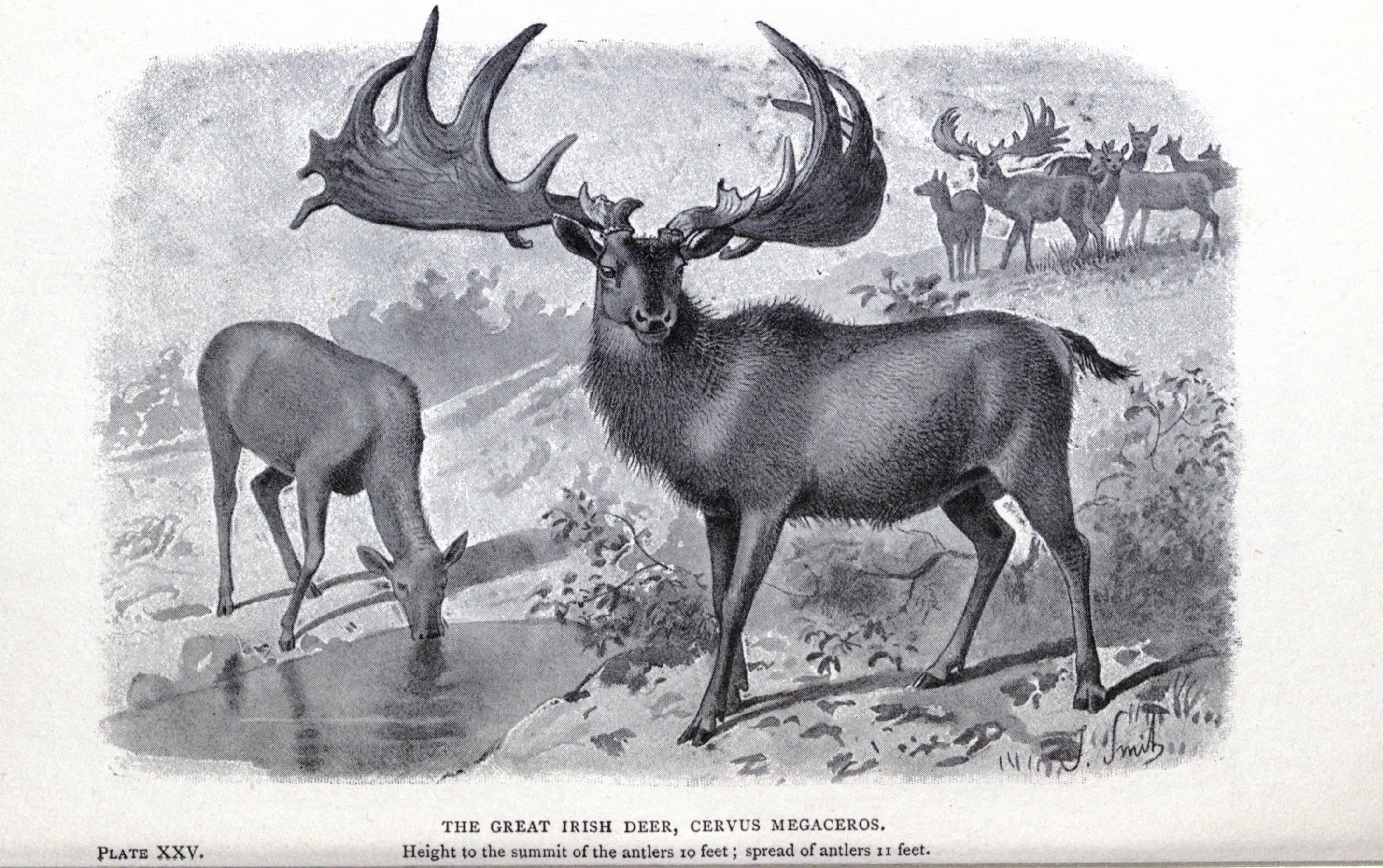
This is often like the human condition for the individual. We have such capacity for empathy and sensitivity that the result can be self-sabotage. A flower dies, or an eagle takes a squirrel, and we feel pain for things that do not feel pain themselves. Scorned by a lover or a friend, we are struck by bouts of emotion which may fall outside the bounds of rational thought.
Often when we feel pain, there exists some more mechanical, logical, and ostentatious voice which proclaims that everything could always be worse. If we cut ourselves on paper, we may be reminded of the people who have limbs severed by giant machinery. When we have little money, we consider the individuals with no money. If we erode into a depressive state, there is an idiotic notion that we should be comforted by having a roof over our head or by the fact that we were not born starving in Sudan or some other distant corner of the third world. But of course this sort of argument does very little good.
Suffering is something which happens internally. It is affected and moved by external forces, perhaps, but the phenomena which transmute these events into pain are internal. What hurts he may not hurt she. This is made plainly obvious when we consider that the world's sufferings do nothing to comfort our own. People like to say that misery loves company, and maybe this is true, but company does not heal misery.
The pain of the world's poor does not alleviate our own woes. We do not smile when others frown. We do not exalt one another's scream. If anything, maybe the opposite is true. We feel empathy, and the sadness of the world becomes the sadness of the individual.
There is, too, no true zero for pain. A man cannot live in a utopia—no matter how perfect anything may be. We will always feel pain. When we are at our most satisfied and content in life, we still feel sorrow over this or that. So to treat pain and suffering like some objective, measurable quality of life is surely a foolish pursuit.
Pain is too made difficult by its tendency to elude vocabulary. How often has the depressed individual been prompted by some version of "What do you have to be sad about?" or "Look at X, Y, and Z qualities of your life—why should you be in sorrow?" These are bad questions because they have no answers. Some unique sorts of pain are so great and so large that they cannot be captured by language. In a turn of irony, the human mind which created our language is unable to produce rhetoric which accurately categorizes this most serious of pain.
So we are left quite alone, unable to communicate our suffering to anyone—and even unable to communicate it to ourselves. We can feel it, and we can see it all around us, but words do not exist to match the pain. So we suffer even greater in solitude. There, in solitude, is where we know our pain most accurately—but it is cruelly where our pain strikes the hottest and most intensely. There even joy reminds us not to feel joyous, but of the thing which we cannot find. It is a top-shelf item in a store, out of reach, but tremendously visible.
Trauma
The word trauma has been used in modern parliaments maybe to the point of exhaustion. I once looked diminutively at the word, and when I heard people proclaim "trauma," I recoiled with agitation and exhaustion. But I have realized the concept of trauma remains true and real, regardless of how casually that word may be thrown around. I must also consider that trauma is part of pain, and so it is just as subjective as that concept.
Trauma plays a very mean hand to its sufferer. It does not impact only the things which are immediately relevant to the traumatic pain. Instead, it can fundamentally realign one's wholesale perception of the world. This sort of pain forms a giant crevasse between the emotional and the rational sides of the spirit. A person may feel that life is generally a good and safe place, that it is not populated by monsters. So if that person is the victim of some singular event wherein humanity shows its cruelty and violence, they are left with a fundamental rift in how they perceive the world. If the world is X, why did Y happen? This can call into serious question all that we feel and know about the world in which we live—about the nature of humanity. Suddenly a person is stricken not only with the pain of the event, but with the pain of disillusion—the pain that perhaps, on a very fundamental level, they do not know or understand the world.
The concept of trauma has a particular enemy of thought in the English language. People like to say "What doesn't kill you makes you stronger." Sometimes, maybe. But I'm reminded of a dolphin which has its fin severed by a boat propeller. The dolphin may continue swimming, and the wound may heal. But the dolphin is not stronger. It is weaker. It cannot hunt so effectively. It cannot swim so quickly. Each time it hears the familiar roar of an outboard motor—even at a distance—it is fractured and hides. To cover.
Things can hurt humans and make us weaker, too. Wounds of the flesh must heal, or a human will die of blood loss or organ failure. Wounds of the spirit do not have this quality. They do not need to heal. We can go on through life limping and cowering, and even the most vague cacophonies, like the dolphin hides from his boats.
Inevitable Pain
We often strive to arrange life in a way which protects us from pain. This is understandable and maybe even natural. But it is also an impossible task. To be protected from pain, we must understand that suffering is unavoidable. We will all endure it in our lives, and to seek a pain-free world is a meaningless search.
Consider maybe a wooden boat which has had dozens of holes drilled into its structure, and it laps in the tide. If we plug one hole, more water pours through the rest. If we plug two, three, or four, we only increase the pressure of the water which pours into the boat. Like the salt water will always seek these holes, pain too is unstoppable in its cunning.
Certainly, we should not actively seek pain, or champion suffering, or envy those in sorrow. We also must not abandon our brothers or sisters in moments of crisis. But we should recognize that suffering is an inexorable part of the human condition. To live is to feel many things, and one of them is pain.
But pain is neither bad nor good. It is instead an ecosystem, which at once contains decay and growth. I do not agree with the hardline notion that pain is good, that suffering makes us better—but I do believe that being a quintessential piece of life, we should seek for and identify the benefits of pain. We too often regard feelings of pain as weakness, as if these sensations are relegated to only a few among us. This is, of course, false.
So we must find something to do with our pain. We must identify how it holistically impacts our condition. Pain is like a stone we are forced to carry, and so we would be best served not to languish only in obligation, but instead we may see if this stone can be used for other purposes.
In his essay The Palliative Society: Pain Today, contemporary writer Byung-Chul Han discusses the role of pain. He points to many of the beauties of pain, which I do think are real. Pain is love, and love is pain. It is by accepting the potentiality of pain that we can enter into life's most fulfilling relationships. Further, we know these relationships are true and fulfilling by their capacity to enact anguish.
Byung-Chul notes: "Everything which is true is painful." With our loved ones, a rift or even separation which causes suffering shows that the relationship bursts with truth. The seams of the world are revealed to us by pain. The things which we love are those same ones which cause us the most pain. Where we can suffer, we can feel life. The potentiality for pain is like a barometer of truth. Where there can be no pain, there can be no happiness.
I challenge the viewer here to imagine something truly worth doing which is simultaneously incapable of causing anguish. Pain draws the anatomy of our lives. We are able to understand what is most important by what hurts the most when it is maimed or severed.
Pain, too, reveals beauty in creative pursuits. This is fundamentally true. Byung-Chul points to a letter written by Franz Kafka. In the letter, Kafka says that writing was a reward for the fact that he was, quote, "pinched, beaten, and ground nearly to dust by the devil." Thus for Kafka, to write was inseparable from his suffering.
Pain can be the kindling for our highest creative pursuits—for our imagination itself. Creativity may be a sword we are forced to forge as the world presents us with pain. We see darkness, and we must imagine light. We cannot heal, so we must heal ourselves. We must build a world in which we can take refuge from pain. The anguish is a demon most certainly—but the world we build in defense against it is more holy and spectacular than our suffering could ever be.
Pain pushes us into the new. It propels us forward. It fractures our attachment to old ideas and concepts. Without discomfort, we would be most perfectly happy to remain as-is forever. Disruption tears apart conception and forces us to build new ones. To become better and more whole is to change—and change only comes when we experience discomfort.
It bears repeating that pain is not inherently good—but it is not also wholly bad. It is neither. Suffering just is. We cannot remove pain from our world. If we try to do so, we only remove our capacity to deal with pain. If we attempt to free ourselves of pain entirely, or even convince ourselves that we have done so, then we find a dangerous situation—one certainly more dangerous than accepting pain as a reality of life.
This situation is the type that led me to my suicide attempt. We experience the inevitable pain, but we have been unable to equip ourselves in preparation, and we are now unable to transmute the feelings once they have flooded our soul. This is precisely the point. We should not invite pain, or let undue pain run amok in our world—but we must also not build some illusory existence where pain is something we can eliminate. We must prepare for, understand, and be able to cope with suffering in its endless incarnations.
Life as a valley
I once thought of life as a mountain. To me, it was something we must climb and summit with some grand destination in mind. Life was one large obstacle, and we were meant to spend our days conquering that obstacle. Pain was the stumble from the mountain, the misstep that decayed ascension. Perhaps even life itself was a fight in pain. I have since abandoned this idea.
I think life is not a mountain—but a valley which we walk through. It is ambivalent in totality, functioning as its own ecosystem—but it is incredible in its many pieces. The flying seeds of dandelion are the stirrings of town and its residents. The grass massages my feet like my cat's paw in my lap on a cold evening. The sun, too, shines like the smiles of those I love—which fade in time and are replaced by nights of darkness only for the day to inevitably reemerge.
Bees tend to their flowers, and they may sting me as they do so—but this is owing not to my actions, and instead to machinations and psychologies which always I cannot or need not understand. As I walk through the meadow, I know I will one day and in due time reach the tree line where this valley disappears into the darkness of a forest. I hope that by then, I have appreciated the valley so intensely that I can only welcome a change of scenery.
You might Also Like

Capitalism, Neoliberalism, and the Loneliness Epidemic - Unraveling the Ties That Bind Us
Loneliness in society is deeply rooted in capitalist structures and neoliberal values. Addressing this requires both individual actions and systemic changes to foster social connections and mental well-being. Reaching out for help and fostering connections is crucial, as loneliness should be viewed as a signal for the essential need for social connection.
Read More
When Artificial Intelligence Begets the Organic - The Rise of Post-Human Intelligence
Bias is part of being human. We have positions, perspectives, cultures, lenses through which we see things. AI models are trained through reinforcement learning — gently nudging the AI in particular directions. But there is often no single correct answer to an ethical question. David Hume famously argued that you cannot derive an ought from an is — you cannot determine what the world should look like from what it currently is. The data is biased by history. And it is being further shaped, nudged, and corrected by a very specific group of people in a very specific part of the world at a very specific moment in history.
Read More
The Rise & Roots of Global Populism - Tracing Democracy’s Inextricable Shadow
Populism presents democracy with its most fundamental contradiction—it emerges from democratic systems while potentially destroying them. Every populist movement claims to represent "the people" against corrupt elites, yet "the people" are never actually singular. They're millions of individuals with conflicting interests who disagree with each other constantly. This creates an impossible logical problem: how can any leader authentically represent such diversity? The answer is they can't, which is why populist movements inevitably rely on charismatic, often eccentric leaders who become the very type of elite they claim to oppose. Populism isn't going away because it reveals genuine flaws in how modern democracies work. When democratic institutions fail to represent significant portions of the population—the "forgotten rooms" of society—populism emerges as both symptom and potential cure. The real challenge isn't defeating populism but addressing the underlying conditions that make it appealing: the sense that ordinary people have lost control over their lives, increasing inequality, and governance by distant technocrats. Until we solve these problems, populism will remain democracy's persistent shadow, offering solutions that might cure the disease by killing the patient.
Read More
